
Ford Engine Care Guide: Protecting Your Ford’s Engine for the Long Haul
When we talk about routine auto maintenance, items like tire rotations, fresh wiper blades, and synthetic oil refills usually get the spotlight. But behind every confident acceleration down Highway 47, every heavy payload towed up into the Coast Range, and every smooth morning commute into Portland, there is a complex network of mechanical heavyweights doing the hard work: your vehicle’s powertrain and drivetrain.
While preventive care keeps these systems running quietly
in the background, ignoring small warning signs can quickly turn a minor
maintenance task into a major mechanical overhaul. Your engine operates under
extreme thermal stress, high pressure, and precise mechanical tolerances.
Protecting that investment requires a proactive mindset that connects routine
service with long-term powertrain health.

At Doherty Ford, we strive to make service easy and
effortless. Whether you drive a fuel-efficient Ford Fusion, a hybrid crossover,
or a heavy-duty Power Stroke diesel pickup, this guide breaks down how your
engine and drivetrain work together, how to respond to warning lights, and how
to avoid costly emergency repairs.
Powertrain vs. Drivetrain: Understanding the Heart of Your
Vehicle
To understand why preventive care is so critical, it helps
to distinguish between your vehicle’s powertrain and its drivetrain. While
people often use the terms interchangeably, they refer to two distinct
mechanical systems:
-
The Powertrain: This includes everything that
generates energy to propel your vehicle. The primary component is the engine
itself, along with the transmission, fuel delivery network, exhaust system, and
engine control module (ECM).
- The Drivetrain: This encompasses all the components that take the kinetic energy produced by the engine and transfer it directly to the pavement. It includes the driveshaft, differential, CV joints, axles, and transfer case (in four-wheel-drive or all-wheel-drive models).
When every gear, bearing, and seal in these systems is
properly lubricated and thermally stable, your vehicle delivers effortless
power, sharp throttle response, and maximum fuel efficiency. However, when
friction or extreme heat builds up, the risk of
needing major auto engine repair increases dramatically.
Integrating routine inspections into a broader car preventive maintenance strategy ensures
that small issues, such as a slow axle seal leak or an aging serpentine belt, are
caught long before they disrupt your drivetrain.
Don’t Ignore the Amber Glow: When You Need Check Engine
Light Repair
Few dashboard symbols inspire as much sudden anxiety as
the illuminated engine outline on your instrument
cluster. While it is tempting to hope the light is just a temporary digital
glitch, an active warning is your onboard computer's way of telling you that a
diagnostic code has been triggered.
Understanding how to read these alerts can save you from
severe, compounding damage:
Solid vs. Flashing Warning Lights
-
A Solid Check Engine Light: This indicates a non-emergency
fault that still requires timely attention. It could point to a failing oxygen
sensor, an EVAP system vapor leak (sometimes as simple as a loose gas cap), or
a mass airflow sensor tracking improper air-to-fuel ratios. While the vehicle
remains drivable, ignoring a solid light can degrade fuel economy and
eventually damage your catalytic converter.
-
A Flashing Check Engine Light: This represents an active,
emergency mechanical failure, most commonly a severe engine misfire. Unburned
fuel is entering the exhaust system, where it can rapidly overheat and melt the
internal structure of your catalytic converter. If your check engine light is
flashing, pull over safely immediately and schedule service.
The Danger of Postponing Diagnostics
Modern Ford engines rely on dozens of sensors feeding
real-time data to the computer. When a sensor fails, the engine defaults to a
basic "limp" profile to protect itself, running richer and burning
more fuel. Professional check engine light repair does not simply clear
the code; it uses specialized diagnostic scanners to read freeze-frame data,
isolate the root electronic or mechanical failure, and restore your
powertrain’s precise air, fuel, and spark ratios.
Beat the Heat and Hills: Preventing Engine Overheating
Repair
Driving around Washington County exposes your engine to
diverse stresses. From crawling through humid, stop-and-go traffic along
Highway 8 to hauling heavy cargo up steep mountain passes toward Gales Creek,
your cooling system is under constant pressure.
An engine produces immense thermal energy. If that heat is
not continuously dissipated, internal metal components can expand beyond
factory tolerances, leading to warped cylinder heads, blown head gaskets, or
cracked engine blocks.
The Anatomy of an Overheating System
Your engine’s cooling matrix relies on several
interconnected components:
-
The Coolant (Antifreeze): A chemical blend of water and
glycol that absorbs engine heat and prevents internal corrosion. Over time,
coolant degrades, becoming acidic and losing its heat-transfer efficiency.
-
The Thermostat: A heat-sensitive valve that
regulates coolant flow between the engine and the radiator.
-
The Water Pump: The mechanical heart of the
cooling system, continuously circulating fluid through the engine block.
- The Radiator and Cooling Fans: Dissipates heat into the outside air as fluid flows through thin aluminum fins.
Common Causes of Engine Overheating
When an engine begins to run hot, the culprit is usually a
loss of pressure, a fluid leak, or a mechanical restriction. Pin-hole leaks in
aging radiator hoses, a stuck thermostat, or a failing water pump impeller can
instantly disrupt fluid circulation.
Recognizing early warning signs, such as a temperature
gauge creeping past the midpoint, sweet-smelling steam rising from the grill,
or puddle spots under the front bumper—is crucial. Seeking prompt engine
overheating repair at the first sign of trouble prevents thermal warping
and preserves your engine block’s structural integrity.
A great way to keep tabs on your fluid levels and cooling
hose condition is to request a comprehensive health review during your regular
service visits, making it easy to track milestones in your ford essential maintenance guide.
Heavy-Duty Performance: Specialized Diesel Engine Repair
& Maintenance
For many drivers across Forest Grove and rural Oregon,
heavy-duty trucks like the Ford F-250 and F-350 Super Duty are essential tools
for work and daily life. Power Stroke diesel engines offer incredible torque,
high towing capacity, and long-term durability, but their mechanical
architecture requires specialized care compared to standard gasoline engines.
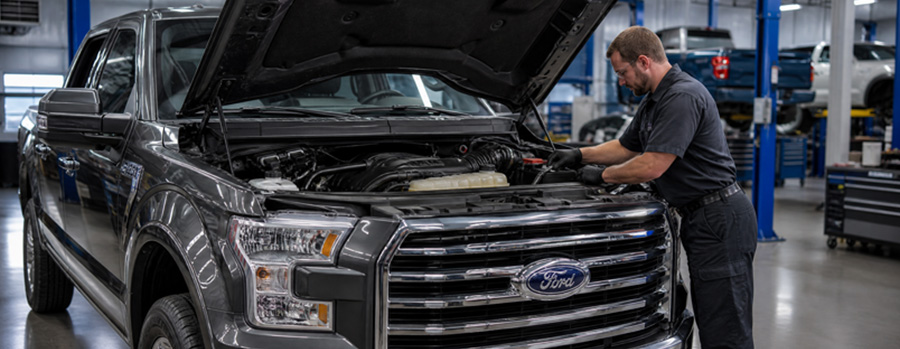
Diesel engines operate under significantly higher
compression ratios and utilize complex forced-induction networks to deliver
their signature power. As a result, maintaining a diesel powertrain demands
precise attention to specific components:
Key Areas of Diesel Engine Care
·
Fuel Filter Replacement Cycles: Diesel
fuel contains more moisture and microscopic particulate matter than gasoline.
Power Stroke engines utilize dual fuel filters to trap water and debris before
they reach delicate high-pressure fuel injectors. Clogged
filters restrict fuel flow, causing power loss and potentially destroying
expensive fuel pumps.
-
Turbocharger Integrity: Modern diesels rely on
variable-geometry turbochargers to force pressurized air into the combustion
chambers. Ensuring clean engine oil flow is vital, as oil cools and lubricates
the high-speed turbo bearings.
-
Exhaust Aftertreatment Systems: To meet
emissions standards, modern diesels utilize Diesel Particulate Filters (DPF)
and Selective Catalytic Reduction (SCR) systems requiring Diesel Exhaust Fluid
(DEF). Driving short distances without letting the exhaust reach high
temperatures can clog the DPF, requiring specialized cleaning or manual
regeneration cycles.
- Oil Shear Resistance: Because diesel engines subject motor oil to immense mechanical shearing forces and high soot loads, using the correct oil grade and viscosity is paramount. You can dive deeper into how oil breakdown affects severe-duty engines in our detailed oil change and service guide.
When issues do arise, whether it's a loss of boost
pressure, hard cold starts, or excessive exhaust smoke, seeking specialized diesel
engine repair from technicians who understand Ford Power Stroke engineering
tolerances is essential for keeping your truck on the job.
Protect Your Investment Before the Warning Light Comes On
Your vehicle’s engine and drivetrain represent its most
sophisticated, high-value mechanical systems. Waiting for a major component
failure on the highway or a sudden cloud of steam under the hood turns a
preventable maintenance item into an expensive, stressful emergency.
By combining routine oil changes, seasonal fluid checks,
and prompt attention to dashboard warning lights, you protect your powertrain
against friction, heat, and premature wear. Whether you need a routine
diagnostic checkup, cooling system service, or specialized car engine repair,
the team at Doherty Ford is here to keep your vehicle performing reliably over
every Oregon mile.
Schedule your next service evaluation today and drive with complete confidence!