
Understanding Ford's Suspension System: Components, Signs of Wear, and Repair Guide
When we think about vehicle performance, we usually focus on horsepower, torque, and braking distances. But there is a silent partner working beneath your vehicle that dictates exactly how your vehicle handles, stops, and feels over every bump: the car suspension system.
For drivers in Forest Grove navigating
the rough gravel logging roads, mountain passes, and highway potholes of the
Pacific Northwest, a healthy suspension is the difference between a smooth,
safe ride and a dangerous, unpredictable drive.
Integrating a suspension check directly
into your comprehensive car preventive maintenance strategy is the most effective way to avoid unexpected failures and
keep your vehicle operating flawlessly for the long haul.
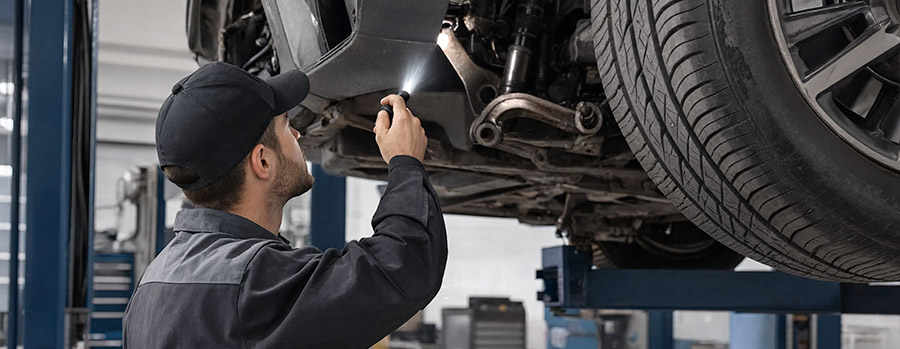
At Doherty Ford, we strive to make
vehicle care easy and effortless. Below, we break down how your suspension
works, the signs it is failing, and what to expect during a professional repair
or service.
What is a Vehicle
Suspension System?
Your vehicle's suspension system is a
complex network of mechanical components designed to perform two crucial roles
simultaneously:
Vehicle Control: It maximizes friction between your tires and the road surface, providing steering stability, handling agility, and ensuring your vehicle doesn't sway or roll dangerously when cornering or braking.
Key Suspension System
Components
To understand how the system breaks down,
it helps to look at the primary suspension system components that
certified technicians inspect during a routine diagnostic:
-
Springs (Coil or Leaf): These support the vehicle’s weight and compress to absorb
major road impacts. While passenger cars use coil springs, heavy-duty trucks
often feature rear leaf springs to handle massive payloads.
-
-
-
-
Crucial Signs of a Bad Suspension (And Why They Happen)
Because suspension components degrade
gradually over thousands of miles, it is incredibly easy to unconsciously adapt
to a worsening ride until your road safety is actively compromised. When
components begin to give out, they leave distinct operational clues.
Understanding exactly what these symptoms
mean and the precise failures causing them, will
help you catch damage before it spreads to your vehicle's drivetrain.
1. A Harsh, Bumpy Ride
If every dip, pothole, or crack on
Highway 47 sends a jarring shockwave straight through your seat, your vehicle's
dampening system has failed.
-
The Structural Breakdown: Shock absorbers utilize a precision piston inside a chamber
filled with hydraulic fluid to control the speed at which your vehicle's
springs compress and rebound. Over time, internal rubber seals crack, causing
this vital hydraulic fluid to leak out completely. Without fluid resistance,
there is nothing left to absorb the kinetic energy of the road.
-
2. Extreme Weight Shifts: Diving, Rolling, or Squatting
When a suspension system loses its
internal structural resistance, it can no longer manage the intense kinetic
forces generated by momentum changes. This results in unstable, unsafe body
shifting during basic driving maneuvers.
-
Front Nose-Diving During
Braking: When you slam on the brakes, momentum
naturally shifts the vehicle's weight forward. If the valving inside your front
struts is spent, they cannot resist this downward force, causing the front
bumper to dive violently toward the pavement. This severely delays your braking
response time and rapidly accelerates front brake pad wear.
-
-
3. Failing the Classic "Bounce Test"
The bounce test remains one of the most
reliable diagnostic indicators of completely worn shocks or struts. If you push
down firmly on your vehicle's bumper and it continues to oscillate, sway, or
bounce more than two times after you let go, the vehicle is structurally
unstable.
- The Mechanical Root Cause: Vehicle springs are excellent at storing energy from bumps, but they have no physical way to stop moving on their own. The internal piston valving of your shocks or struts is solely responsible for "killing" that spring bounce instantly. Continuous bouncing means the shocks or struts are no longer providing adequate damping, forcing the vehicle to rely purely on dangerous spring elasticity.
When suspension components fail to hold
the wheel perfectly flat against the road surface, your tires bear the brunt of
the damage, leading to rapid, uneven tread wear that ruins your wet-weather
grip long before its time.
-
Tire Cupping (Scalloped
Dips in Tread): If you notice smooth, scalloped low
spots worn into the tire tread, it means the tire has literally been bouncing
down the road like a basketball. This structural failure occurs because
worn-out shocks or struts can no longer keep the tire firmly, consistently
planted against the pavement at highway speeds.
-
Truck Suspension Repair vs. Car
Suspension Repair
When it comes to fixing these systems,
cars and trucks require completely different approaches due to their structural
designs:
-
Car Suspension Repair: Focuses heavily on precision alignment, ride comfort, and
complex multi-link independent layouts or MacPherson strut assemblies. Worn
struts, control arms, and stabilizer links are the most common culprits.
-
What to Expect During a Ford Suspension Service
When you bring your vehicle in for a
professional suspension service, a factory-trained technician strips away the
guesswork using specialized diagnostic racks.
The service begins with a comprehensive
physical evaluation of all bushings, boots, and linkages to look for dry rot,
physical play, or structural cracks. Technicians check shock absorbers for oily
residue, which indicates an internal hydraulic fluid leak. Following any parts
replacement, a precision laser wheel alignment is performed to reset your
steering tolerances back to factory specifications.
At Doherty Ford, our certified technicians specialize in both car and heavy-duty truck suspension systems, utilizing genuine Ford OEM components built specifically for your vehicle framework. Schedule your inspection today and drive with absolute confidence on every Oregon road.