08 May 2026Every drive in Forest Grove
tells a different story. It could be the daily crawl down Tualatin Valley
Highway, a rainy school run through town, or a weekend escape to Henry Hagg
Lake with the family packed in the backseat.
But no matter where the road leads, every mile
depends on the point of contact connecting your vehicle to the pavement: your
tires.
At Doherty Ford, we’ve been a
cornerstone of the Forest Grove community since 1948.
And we understand that tire
maintenance isn't just a box to tick on a service checklist; and that it's the
foundation of your vehicle's safety, fuel efficiency, and performance,
regardless of what badge is on your grille.
In this guide, we’ll break down
everything from the technical nuances of Ford tire service to the specifics of
wheel alignment for all makes and models, helping you maximize the lifespan of
your rubber and the health of your vehicle.
Importance of Regular Wheel Rotation Service
Tires do not wear out at the
same rate. On a front-wheel-drive (FWD) vehicle, the front tires handle the
steering, the majority of the braking force, and the engine's power. On a
heavy-duty truck or any RWD work vehicle, the rear tires might bear the brunt
of heavy payloads.
How Often Should You Rotate Tires?
According to industry standards
for most vehicles, you should schedule a wheel rotation service every 5,000 to
7,500 miles. Regular rotation ensures that all four tires wear down at an even
rate, which:
·
Preserves Your Warranty: Many tire manufacturers
require proof of regular rotation to honor tread-life warranties.
·
Saves Money: By evening out the wear, you avoid having to replace two
tires prematurely while the others still have life.
·
Balances Traction: Even wear means consistent
grip across all four corners, which is vital for Oregon’s rainy winters.
There will also be specific
patterns recommended in your Owner’s Manual, like the "Forward Cross"
for FWD cars or the "Rearward Cross" for RWD and 4WD trucks. At
Doherty Ford, we ensure you’re getting the right pattern for your specific
drivetrain.
What Does a Wheel Alignment Service Entail?
If your vehicle
"pulls" to one side or your steering wheel is off-center while
driving straight through Forest Grove, your alignment is likely out of spec.
However, alignment issues are often invisible until the damage is already done
to your tires.
The Three Angles of Alignment
During a professional tire
alignment, the focus is on three primary measurements:
1.
Camber: The
inward or outward tilt of the tire when viewed from the front.
2.
Toe: The
extent to which your tires turn inward or outward when viewed from above.
3.
Caster: The
angle of your steering axis, which helps with steering balance and stability.
Forest Grove’s potholes and
gravel shoulders can easily knock these angles out of alignment on any car,
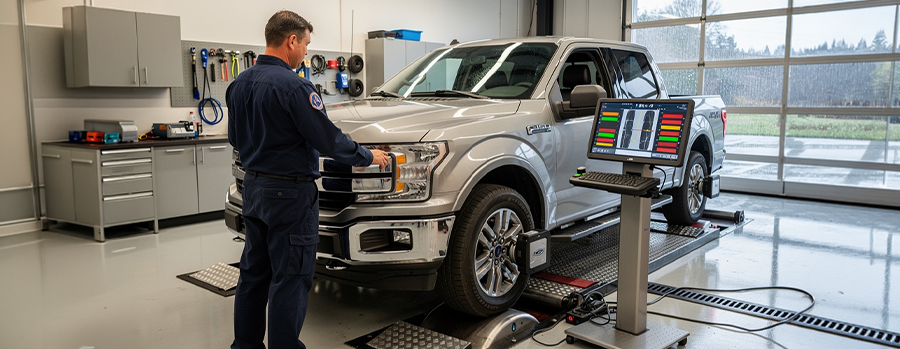
truck, or SUV. Our state-of-the-art computerized alignment rack ensures your
vehicle is returned to the exact factory specifications, reducing "rolling
resistance" and improving your MPG.
Why Wheel Balancing Service Matters?
While alignment deals with the angles of your tires, wheel balancing
ensures that weight is distributed perfectly around the axle.
Even a tiny weight discrepancy, sometimes
as small as a fraction of an ounce, can create significant issues when a tire
spins hundreds of times per minute at highway speeds.
When should you balance? If you feel a rhythmic
vibration in the steering wheel or floorboards, typically starting above 50
MPH, your wheels are likely out of balance. This doesn't just ruin your comfort, it causes "cupped" tire wear and
puts unnecessary strain on your shocks and bearings.
During a professional wheel balancing service, computerized spin
balancers are used to identify "heavy spots" and apply precision
weights to the rim. We recommend a balance with every tire rotation to ensure
your vehicle remains vibration-free on every Forest Grove backroad.
Tire Pressure Monitoring System (TPMS)
Services
Modern vehicles are equipped
with a Tire Pressure Monitoring System (TPMS), a sophisticated electronic
safety feature which monitors the air pressure inside your tires.
When that "low
pressure" light illuminates your dashboard, your first step should always
be a manual check. Pull over safely and use a physical tire pressure gauge to
verify the PSI in all four tires (and the spare). Often, a simple top-off of air
to the manufacturer’s specifications will turn the light off.
However, if your tires are at
the correct pressure and the light remains stubborn, the issue likely lies
within the system itself.
·
Safety: A non-functioning TPMS means you won't be alerted to a
slow leak or a sudden drop in pressure.
·
Accuracy: Aim to use genuine sensors and high-quality parts
designed specifically for your vehicle's electronic architecture, ensuring
seamless communication with your vehicle’s computer.
Seasonal Tire Service Tips for Forest Grove
Our local climate presents
unique challenges. From the dry heat of July to the consistent drenching rains
of November, your tires have to work hard.
Hydroplaning Prevention
In Oregon, "wet grip"
is the most important tire stat. When tread depth drops below 4/32 of an inch,
your tire’s ability to "evacuate" water decreases significantly. Our
tire service includes a wet-weather safety check to ensure you stay glued to
the road during heavy downpours.
Winter vs. All-Season
While all-season tires are
great for general use, if you frequently head toward the Coast Range or the
Cascades in your SUV, you may want to discuss dedicated winter tires or
"All-Weather" tires (bearing the Three-Peak Mountain Snowflake symbol)
with our parts department.
What Does Different Tire Wear Patterns Mean?
Your tires are like a health
report for your suspension. During a wheel rotation service, our techs look
for:
·
Feathering: Often a sign of improper toe alignment.
·
One-Side Wear: Usually indicates a camber
issue or a bent suspension component.
·
Cupping: Scalloped dips in the tread often mean your shocks or
struts are worn out.
By catching these patterns
early at Doherty Ford, we can fix the underlying suspension issue before it
ruins a brand-new set of tires on your vehicle.
DIY Tire Maintenance Tips for Owners
While we recommend professional
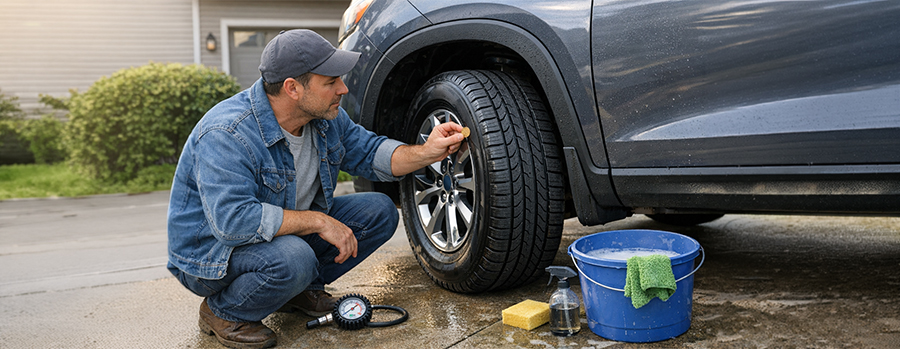
service, there are things you can do at home to extend the life of your tires:
·
Check Pressure Monthly: Tires can lose 1-2 PSI per
month naturally. Check them when they are "cold" (before driving) for
the most accurate reading.
·
The Penny Test: Insert a penny into the tread
with Lincoln's head upside down. If you can see all of Lincoln’s head, your
tread is dangerously low (less than 2/32”).
·
Keep it Clean: Wash off road salt and brake
dust regularly to prevent corrosion on your wheels and TPMS sensors.
Why Professional Expertise Matters for Every Make
When searching for tire
service near me, you’ll find plenty of generic shops. However, modern
vehicles, from high-torque F-150s to precision-engineered European imports, have
specific requirements for load ratings, speed ratings, and tread patterns.
The Doherty Ford Advantage
Our technicians are factory
trained. This means they aren't just "changing tires"; they are
inspecting the complex systems that interact with them. Our team is fully
equipped and certified to work on all makes and models. A professional tire
service at our Forest Grove facility includes:
·
Detailed Tread Depth Measurement: We use
precision gauges to measure "inner, outer, and center" wear to
diagnose suspension issues before they become expensive repairs.
·
Sidewall Integrity Checks: Oregon’s rural roads can be
tough. We look for bulges, cracks, or "dry rot" that could lead to a
dangerous blowout.
·
Bead and Rim Inspection: We ensure the seal between
your tire and the wheel is airtight and free of corrosion, a common issue in
our damp climate.
Get Expert Tire and Alignment Service
Don't wait for a vibration in
the steering wheel or a warning light to take action. Proactive maintenance is
the key to a long-lasting vehicle. Whether you need a simple wheel rotation
service, precision alignment, or a tire pressure sensor replacement, the team
at Doherty Ford is here to help.
Doherty Ford is your local auto
expert in Forest Grove, dedicated to keeping your vehicle safe and reliable for
the miles ahead.
Contact us today to schedule
your next tire service and experience the Doherty difference!